
It was a cold December day in 2017.
Icy rain outside – the type that goes through your bones.
I was lost… Unable to reconcile who I was with who I wanted to be. I didn’t like who I was and I couldn’t think of what I wanted to do or who I wanted to be. I felt trapped and isolated, a rat trapped in a scientists cage with the floor electrocuted repeatedly at spontaneous intervals – not knowing when the next shock would come, constantly in fight-or-flight.
Huddled under thin blankets, I gazed at my book pile. The day before I had randomly selected a few samples from the library that I thought would be worth reading. Maybe someone, somewhere, had solved this problem.
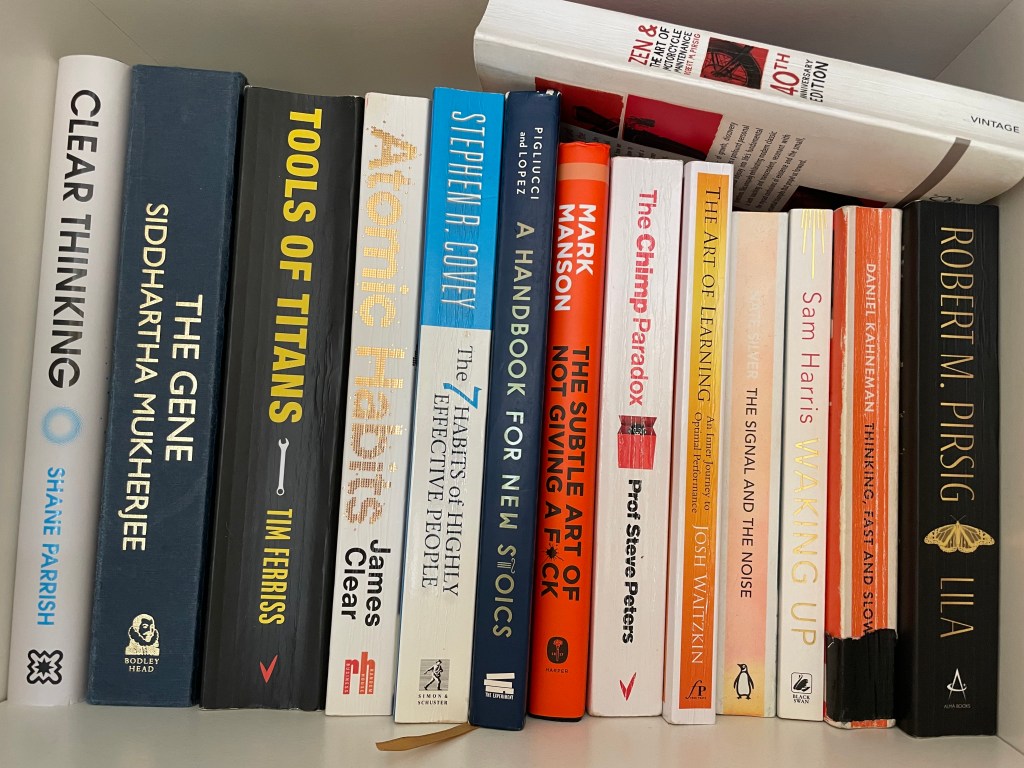
I picked up the first book: a funny red box with a chimp sticking out of it on the front cover. It was called The Chimp Paradox by someone called Professor Steve Peters. I flicked through the book: lots of diagrams, little pictures, bold writing. Looked like a children’s book, not something a Professor would write…
I read the back.
“Do you sabotage your own happiness and success?”
Yes.
“Are you struggling to make sense of yourself?”
Who isn’t?
“Do your emotions sometimes dictate your life?
Bingo – three out of three.
I open the “children’s book”.
I read a few lines, and then a few more, and then a few more.
Because of that “Children’s Book” my life is unrecognisable 10 years later.
The 10 Books That Changed My Life
The Chimp Paradox by Professor Steve Peters
As outlined previously, The Chimp Paradox arrived in my life when I needed it most. Previously I was struggling on all fronts: my relationship with my family was non-existent; the relationship with my friends was based on hedonism; I was drinking too much, smoking too much and getting into unnecessary trouble. I didn’t like myself. I felt like an imposter in someone else’s body. Nothing I did aligned with anything else and I just wanted to escape.
The Chimp Paradox completely changed that. As you’ll learn, you’re a creature with many parts, and the cardinal two are you and your chimp. The neuroscience behind this is solid, and the psychology and philosophy backs this up to. Safe to say that the worst parts of you aren’t you at all – they’re something else.
This book beautifully breaks down the strange creatures that we humans are, and how often we work contrary to our own purpose. Not only does Peters explain Why you throw plates during arguments, but he also tells you how you can create a life in which you don’t.
Better for you, better for the plates.
As a general rule I don’t have many regrets in life, but if I had to choose…
- Not reading this book earlier
- Not starting to meditate early on in life.
So if you answered yes to one of these three questions, do yourself and everyone around you a favour.
- “Do you sabotage your own happiness and success?”
- “Are you struggling to make sense of yourself?”
- “Do your emotions sometimes dictate your life?
Read the damn book.
Zen and the Art of Motorcycle Maintenance by Robert Pirsig
A revolutionary book – never thought I’d say those words about a book.
The only reason it isn’t first is because without the Chimp Paradox my path in life probably wouldn’t have landed me in a position where I would have read this book.
At one level it’s about insanity, at another level it’s a journey about a father and his son travelling the breadth of America, at a third level it’s about existence itself… And I don’t think those are all the levels.
Purchasing the book came about by pure chance – a Quality occurrence (wink wink). Me and my wife-to-be were having a date in Crouch End, London, and walked past a bookstore that offered “Mystery Books”: a booked wrapped in brown parchment with a few bullet points about the theme but nothing else.
I had selected one for my girlfriend at the time that said “Classic, Philosophy, Mystery” on the front. As fate would have it, the book I chose for her was actually for me.
Let me stress that, had I seen this book online or had it recommended to me by a friend, I would not have read it. I would have said something like “It just isn’t my kinda thing.” And yes, I know… The irony of a book recommendation that the author himself wouldn’t have followed isn’t lost on me.
Yet, once started, I couldn’t put it down. I devoured the book in a week and have read it again three times since. It’s on my annual “re-reading” list and, each and every time I read it, I unlock something new.
It’s truly a classic. And being as old as it is, it’s no wonder it still sells to this day.
Trust me – this is one read that will change you, hopefully for the better.
Lila by Robert Pirsig
The sequel to Zen and the Art of Motorcycle Maintenance that fleshes out the metaphysics significantly more. Once you’ve read Zen, you’ll probably read/watch everything you can get your hands on that Pirsig has created.
If that’s the case and you’re hungry for more, I have access to multiple articles, a 4-hour interview and more – just drop me a message in the comments and I’ll forward everything.
Rich Dad Poor Dad by Robert Kiyosaki
This book entered my life when I was seeking wealth, and it delivered.
A real mindset shift happened as a result of reading Rich Dad Poor Dad: understanding that assets are more important than a high paying job; that what you own tends to end up owning you; that the primary difference between wealthy and non-wealthy people is mindset first, intelligence and resources second. This approach revolutionized my approach to finances and my general world view.
Whilst there’s been a lot of controversy around the author, the principles and teachings are solid: if you want to be wealthy, then invest in assets and minimise liabilities. And whilst that sounds simple enough, reading the book goes into a more methodical way of thinking about and approaching wealth than I can cover in this post.
Sounds simple, but just wait until you get started to see how hard something so simple can be.
Sapiens by Yuval Noah Harari
Well, it’s a best-seller for a reason. Harari explains very well the story of our ancestors, of you and me, how we came here and why we have the overwhelming presence we do. It’s rare that any species dominates the planet in the way that humans have, and Harari’s notion of inter-subjective imaginary forces is a genius insight.
Particularly powerful, at least for me, was his comment about imaginary fictions that run the real world: the existence of lakes, rivers and lions now depend on fictions: companies (that don’t physically exist), countries (that cannot be realised) and abstractions that mankind has created – that only exist in our imagination, that only exist because we all believe in them.
After all, if everyone stopped believing in money tomorrow, it would just be a random piece of paper. Not only random, but useless! You can’t eat a £50 note. You can’t use it as shelter. All you can do is burn it for some heat.
So this book really, really, really makes you think about how crazy our reality actually is, and makes me think of a quote by a Billionaire Genius: “The Only Laws You Can’t Break Are Physics – Everything Else Is Negotiable”.
Clear Thinking by Shane Parrish
I’ve probably listened to, rather than read, this book at least three times already, and it’s worth every listen. I think of it as having an elite mentor that truly wants the best for you, by your side with a handy solution to anything that you’re struggling with, 24/7.
Parrish is excellent at providing a clear thought through approach for handling pretty much everything life can throw at you.
My favourite: remember the last time you got into a difficult situation or a heated argument, and raised your voice or shouted? Is it that you didn’t know that shouting back or cursing was a bad idea during that argument?
Not for most people, right?
Most people know that the best thing to do during a heated argument is to take a deep breath and to re-frame the situation, because you’re most likely looking at the situation through a “me vs you” lens instead of the much more conducive “us vs the problem” lens.
So, the problem isn’t knowing what to do, the problem is not having a clear enough strategy before the argument for how you will handle arguments. Parrish makes the excellent point that smart people have a strategy for how not to get into an argument in the first place, or minimise the damage when in one, instead of how to handle yourself when you’re about to blow up.
Parrish provides solutions to most domains of life, like handling business decisions or reprimanding your child when they lie, in an expert way with clear examples and step by step instructions.
For me this book has truly been a saver of time, effort, money, sanity and life. And thank God for the “Margin of Safety” mental model.
100% worth reading and/or listening to.
Tuesdays with Morrie by Mitch Albom
A beautiful book.
Based on the true story about a dying professor that reconnects with an old student of his. The student proceeds to ask the dying professor the questions that matter most.
- “Why are we here?”
- “What is death like?”
- “How do I find out who I am?”
This was a book gifted to me by my wife. Everyone that she has recommended this book to has had the same positive reaction I’ve had. It’s like being in the room with Dumbledore as he shares his deepest secrets.
Go hang out with Morrie – the awesome grandpa you never had.
Harry Potter by J K Rowling / The Dark Tower by Stephen King / Lord of the Rings / The Hobbit / Marvel Universe / DC Universe
I know, I know… Cheat answer, because here I’m clumping together The Dark Tower Series, Lord of the Rings, The Hobbit, Harry Potter and all other Mythological Heroes. But the reason why these heroes exist in the first place is because this is what we value as humans. If we didn’t, they wouldn’t be as popular as they are.
There’s a reason why Harry Potter and Stephen King sell out stadiums and sign multi-million deals: after all, have you ever thought about how weird it is that Rowling became richer than the Queen after writing Harry Potter?
It’s just a children’s book, right?
How the hell does that have more £££ than most of the companies on the stock market? Because it shows us explicitly something we know implicitly: the Hero’s Journey.
The Hero’s Journey is always underneath the great narratives of society. From Harry Potter to George and the Dragon, from Batman to Lord of the Rings, it’s the same message: risk your safety and security, face the thing that everyone else is afraid to face, go out and have an adventure, be a good truthful person to your friends and family, fight for what’s right and what you’ll receive is a meaningful life at the least, and treasures that you can only imagine at best.
I’m impacted each time I see a person living out their own Hero’s Journey, whether on the big screen or in real life. Whilst us mere mortals aren’t fighting real dragons, we are fighting everyday nonetheless: fear, laziness, addictions, corruption – all in pursuit of what we believe to be true and right: the pursuit of love, truth, nobility.
There’s literally no better narrative to life: go live a full, all-in life, because what the fuck else could be more important than living a life that’s full?
The Subtle Art of Not Giving a Fuck by Mark Manson
If you feel like everything’s a “bit too much”, then read this book.
Manson’s impact was simple but elegant: there’s some things truly worth taking seriously in life and he reminds you how to find yours. After all, not everyone thinks “family and friends” are the only things worth striving for. Some people just want to do research and nothing else. Others want money. Others still fame. Nothing wrong with that.
Manson’s taken a lot of time to think about these things, and whilst this is mainly another version of stoicism (in my opinion), it’s a brilliant one that I highly recommend.
It’s impact on me came when me and my wife were flying to Italy – I had read the book several months back and decided to get the Audiobook on Audible after scrolling through titles for far too long.
It’s a truly funny and wise book, and it’s not joke to be able to deliver wisdom via humour. That’s art.
Yet underneath the humour were practical lessons I had forgotten: that we ultimately are here once and only once, and that most of the petty bullshit we give too much attention too (like our Amazon parcel being left right outside the house FOR ALL THE NEIGHBOURS TO SEE!) zaps life away from the truly meaningful things: great relationships, great work, great experiences.
P.S. Caution to non-millennials: it’s a hilarious book if you’re a millennial. Gen Z and Boomers: just read Meditations by Marcus Aurelius instead.
The Gene by Siddhartha Mukherjee
Do you have blue eyes?
Did you know that blue eyes are only 10,000 years old? Prior to ~10,000 years ago, no blue eyes.
This book came at a time where I was academically fired up – reading and learning as much about the human condition as I could in a huge push to improve and fortify myself mentally.
Reading this book laid a lot of my biological and genetic foundations, helping me to understand how destiny is (somewhat) written into our life code, DNA, and how much power and influence we have over the “execution” of that code.
I’m not doing it justice, but this book is anything but boring science with a fact-after-fact narrative.
It’s also the story of Siddhartha’s journey into this realm of science. How it transformed him, his family, his life, his world.
I thought of science as a cold, calculating, impersonal mistress until I read The Gene. And in a lot of ways, she is. But this book helped me to see the beauty in science: the interplay between man and nature, and the nature in man.
The 10 Books That Changed My Life
- The Chimp Paradox by Professor Steve Peters.
- Zen and the Art of Motorcycle Maintenance by Robert Pirsig.
- Lila by Robert Pirsig.
- Rich Dad Poor Dad by Robert Kiyosaki.
- Sapiens by Yuval Noah Harari.
- Clear Thinking by Shane Parrish.
- Tuesdays with Morrie by Mitch Albom.
- Harry Potter by J K Rowling / The Dark Tower by Stephen King / Lord of the Rings / The Hobbit / Marvel Universe / DC Universe.
- The Subtle Art of Not Giving a Fuck by Mark Manson.
- The Gene by Siddhartha Mukherjee.
I hope this has been of value, you can let me know in the comments.
Sharing is caring -> if someone would benefit from reading this, share the love.
And remember AFQ: Always Follow Quality.
You can find my work and support me via the below links.
– My Website.
– Substack.
– Twitter/X.
– Medium.
– Reddit.
– Quora.
 Pareto Path
Leave a comment